Tuesday, October 21, 2014

The Costume Dress

Each October, whenever my errands take me to the mall or anywhere reasonably close to a Halloween store, I like to take a look at the costumes. I usually put together my own Halloween outfits, but that doesn't stop me from checking out everyone else's potential costumes. I guess I like knowing what different people are into each year. 

Lately, I've noticed an odd trend in kid's costumes, specifically the costumes for girls. Designers have been dreaming up these outfits that are not actually costumes, but character themed dresses. For example, instead of dressing up as a My Little Pony character, girls can wear a dress in their pony's colors. The dress sports a tutu skirt, a T-shirt style top with a picture of the pony on it, and it comes with a head piece that features tiny ears and a little lock of puffy hair. Is the outfit pony inspired? Absolutely. Yet, no one will think that kid is actually dressed as a pony. Other characters to get the dress treatment are Hello Kitty, Sonic the Hedgehog, Pikachu, Batman, Spiderman, and all the Ninja Turtles.

This design choice begs the question: do little girls actually want character dresses or would they rather have more accurate costumes? Is this really the design that most girls prefer? Or is this design just cheaper to mass produce? Or are designers just incapable of imagining little girls wearing anything other than poofy dresses? I can't speak for kids today, but when I was a small child, I wanted to look like the character I was playing, and settling for a character-themed dress would have felt like a waste of a Halloween.

And yet…

When I was a teenager, I remember reading a short article in a gaming magazine about a Pokemon-themed ball gown. This was not a child's costume, this was formal attire for an extremely upperclass high society masquerade ball where everyone had to wear costume-themed gowns or tuxedos. If anyone arrived in a traditional costume the other guests would probably drop their monocles into their champagne glasses. And for what is was, the Pokemon gown was really nice. It was Pikachu yellow and it had little pokeball pins holding up the scalloped edges of the skirt. I don't know if it was the dress itself or the fact that someone had actually combined video games and women's formal attire, but I liked that dress. So it's not impossible for me to believe that some little girls would prefer the costume dress to a traditional costume.

Of course, the role of the costume dress may be something different altogether. My cousin, the mother of two young daughters, pointed out how often costumes double as play clothes these days. It's not unusual to see little girls wearing their Disney Princess gowns to the playground, Kids of all ages and genders wear costume-themed hoodies to school and such. Animal-ear hats have never been more popular. I'm a big fan of this costume-clothes trend. I think it helps kids express their interests while encouraging them to live up to the heroic attributes of the characters they take with them. (Or maybe I just like costume clothes. Either way.) So, if girls are planning on wearing these Halloween costumes year round, maybe parents are more comfortable putting them in a dress that can be mistaken for regular dang clothes instead of letting them run around the playground in a full Hello Kitty mask. My cousin even suggested that some parents are buying multiple costumes for their daughters - the actual costumes for Halloween night and the thematic dresses for everyday wear.

I guess the best thing I can say about costume dresses is that they give girls more choices, and choices are almost always a good thing. (Of course, the more effeminate, harder to design characters like My Little Pony and Hello Kitty seem to only exist in dress form, but that feels like a whole other issue, so I'm gonna move on.) My only big complaint is how many costume shops confusingly categorize the dresses as "girls' costumes" and everything else as "boys' costumes." I have noticed a few shops that designate their costumes as "kids' costumes" and "girls' costumes" which is more accurate (and, I imagine, these labels would sell more merchandise.) Personally, I would label them "kids' costumes" and "costume dresses." Then there would be no confusion.

Parents of daughters, if you haven't gone costume shopping yet this year, I strongly advise you to find out which version of the costume your kids wants before money changes hands. This is another precious opportunity for kids to choose how to express themselves, which is one of the best things* about Halloween.


*Aside from candy.

-Marj

Sunday, July 20, 2014

I Made an Animated Short

I made a short animated cartoon called Cookie Tree. It's about a stuffed turtle. You should watch it and share it with all your friends.


I've been working on and off on this short for about nine months. Here's the story of how Cookie Tree was made:

Cookie Tree started as a project for my animation class. I teach a weekend/summer class on Flash animation to kids, who generally find it difficult, but rewarding. Years ago, some of my students started complaining that making movies in the time allotted was impossible. To prove that it was, indeed, possible, I started making animated shorts along with them. During the school year, the students have, roughly eight hours each month to work on their art in the computer studio. So I would give myself eight hours each month to work on my animations at home. At the beginning of each class, the students could check my work and measure my progress. (I have no plans to post those early shorts online, as I am equal parts proud and ashamed of them.) In the end, the experiment was met with overwhelming indifference. It seems that the students were not really concerned with how possible the assignments were. They just liked complaining. So I ended the experiment.

Fast forward to last November. This year's group of students were different. They might actually appreciate seeing a movie get made. Plus, it had been a long time since I animated anything and I thought it would be good for me to try it again. I had been wanting to make a good short for myself and for my web audiences. Animation class might be a good excuse to make myself start something. I decided to announce the project as soon as I finished the concept sketches.

Coming up with a concept was simple. Each year, our project director gives the students a theme - a broad topic for their art. This year's theme was The Life of a Toy. So I decided to make a short about a stuffed bear who has to go on a short quest through his family's back yard. Only I didn't know what he was questing for or why. 

The rest of the story came to my one evening as I was watching my one-year-old nephew. He was sitting in a bouncy chair, holding a small plush toy. Not surprisingly, he dropped the little animal and it fell to the ground below his feet. The poor kid started stretching a fussing as he hopelessly tried to pick up his little friend. As I handed it back to him, I thought about how frustrated he must have been to have something that he wanted go just barely beyond his grasp. I realized that was what my story was missing. The stuffed animal in my film should be helping a baby. The toy could come to life when only his kid was around and help him do thing that babies can't quite do for themselves. Since my nephew has an impressive collection of plush turtles, the bear became a turtle instead.

First concept drawings


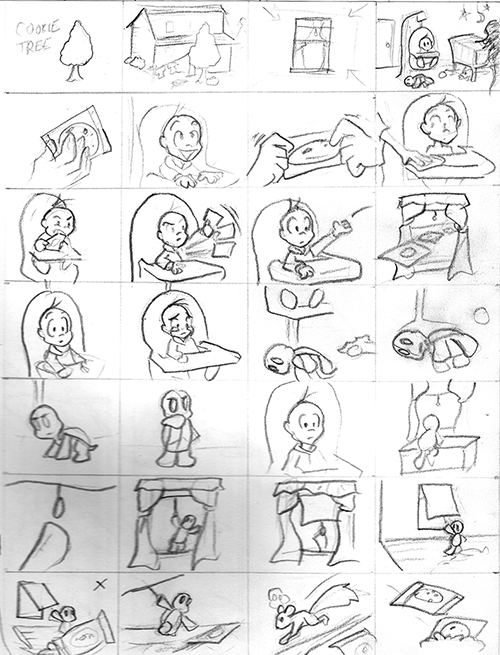
After the kid went home, I finished the concept sketches, most of the storyboard and, later, the animatic. I presented them to my students the following week. This pre-production stuff carried over to the final project pretty faithfully. 


Here's page one of the storyboard, which was later scanned and turned into an animatic. The frame where the turtle wipes his nose was dropped. So was the cookie close up (you can see that frame is maked with an "X") Everything else is in the final film.

Even though the movie would only run for three minutes, it was an ambitious concept for one person to animate alone. I remember joking that I might one day be showing a newly finished film to a confused, fourteen-year-old nephew, who would ask "Why did you make me a baby?" And I, bitter from 13 years of animation, would reply, "because shut yer mouth, that's why."

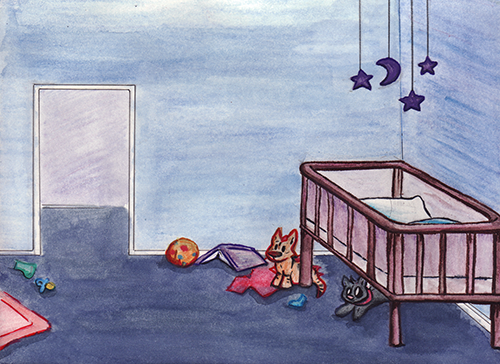
Now that I was ready to start making the actual short, I figured it would be best to begin with the backgrounds. I decided that as long as I was challenging myself, I would really push myself outside of my comfort zone. Usually, when I animate, I draw the character frames by hand and then create the backgrounds digitally. This time, I decided to do the opposite - paint the backgrounds and draw the characters directly in Flash. I started painting the backgrounds shortly after Christmas. I used watercolor pencils for a clean but sketchy look. I had just received a set of rendering markers for Christmas, which I used to add the outlines. Since I was limiting the time I could spend on the project each week, the backgrounds took about a month.

One of the hand-painted backgrounds. The short used fourteen different backgrounds and five painted branches.

Character animation went quickly at first. I placed the backgrounds, drew rough shapes to represent each character, then gradually replaced each rough shape with a finished character made from shapes and lines. That gave me the clean look I wanted, but it was a little tedious and made fluid movements difficult, especially on the human characters. If I ever make another short in this fashion, I'll probably use the digital paint brush for characters outlines.

By the time spring classes had ended, I had finished all the turtle animations, some of the baby animations, and none of the father animations. I squeezed in a voice recording session with my brother-in-law so the movie would be slightly coherent when showed it to my students, with the promise that it would be finished by the time summer classes started up in July. At this point, the limited time rule had also gone out the window and I was giving this project all the time I wanted. (Well, maybe not all the time I wanted. I still finished my comics and went to work and stuff.)

Of course, every project like this has at least one set back, and mine came about four weeks before the film was due. My computer had started running slow and was becoming a little unreliable. In June, it actually destroyed an Urban Underbrush comic, which I grudgingly re-colored hours before it posted. Then it stopped opening the Flash editor, which is kind of important when you're making a Flash movie. I couldn't tell if it was the computer or the Flash program that had gone bad on me, so I took my computer to the shop, where it was diagnosed with faulty sensors. (I already told that story here.) A three-day repair job ended up taking more than a week. I would never have finished on time if my sister, Emily, hadn't lent me her laptop. I was pretty close to the end of the short, so it only took one night of computer-borrowing. I was never happier to stay up all night working on something.

So the animation was finished, but the film had no music. My sister Liz, the musician of the family, had offered to write the music. (I'm making her something in return. I can't talk about it yet, but it will be awesome.) However, since the action scenes have no sound effects, the music had to compliment the actions. The music had to match the timing of the animation, which meant that Liz couldn't even start the music until all the animation was finished. I gave Liz a version of the film and told her that the movie didn't need to debut on the first day of class. As long as it was finished before the first week was up, we'd be okay. We also looked at a few shorts and discussed what the tone of the piece should be. Liz is great to work with. She adds her own ideas, but she also really listens to what I had in mind. The music took Liz a few days, but she nailed it. The movie ended up with a score that feels like a blend of classic pop, video game soundtracks, and storybook themes. I guess that's about right.

I did a little adjustments to the animation to make sure everything was clear, threw in the rest of the sounds (birds chirping and baby crying) and hit the publish buttons.

The movie was presented to my class on July 11. Of course, by this point, it was much more than a teaching tool. I had planned on posting it online to share with my family, friends, and internet followers. A few of my cousins have already seen it before it went live. But it was nice to have my class as a jumping-off point. If I didn't have a reason to make this film, even a reason that I, myself, had invented, I would probably never had finished, possibly never had started.

Thanks to everyone who helped make the film and thanks to those of you who watched it. You make my work possible.

-Marj

Wednesday, July 9, 2014

Voices

Last weekend, I went to Anthrocon (Pittsburgh's furry convention) and got a hug from a stranger who I've known all my life.

I usually visit the con on Sundays to check out the dealers and bug Chris Paulsen. This year, I bought a full attending pass and went every day.

Because this year, they were doing panels and autographs with cartoon voice actors.

This summer, the guests of honor were the amazing Lee Tockar and (wait for it…) the legendary Mr. Jim Cummings! 

Lee Tockar is best known for performing characters for My Little Pony: Friendship is Magic and Transformers Beast Wars. He's also a driving force behind FanBuilt, a community for creative people (which all of you creative people should go check out.)

Now, if you don't know Jim Cummings, I can't possibly explain how awesome he is in the space provided. I'll summarize by telling you that he's best known as the voices of Winnie the Pooh, Tigger, The Tasmanian Devil, and roughly 25% of the Disney Afternoon characters from the 80's and 90's. (Then, I'll urge you to google him and learn more.) There are few people on earth that I would be more interested in meeting than Jim Cummings. As soon as I found out about this year's guests, I bought a weekend pass on the spot - fearing that once word got out that Jim Cummings and Lee Tockar would be visiting Anthrocon, all admission passes would instantly sell out and I'd be left cursing myself for my hesitation.

I need to tell you some stories from my shady past before any tales from this weekend will make sense. First of all, I have never aspired to be a voice actor and I'm very comfortable with my place at the drawing table. Yet, when I turned fourteen and actually started reading the credits of cartoon shows, I found myself remembering the actors' names rather easily. In the beginning, I was only interested in creators. I wanted to know who to admire for making these great stories, great art, and (above all else) great characters. But most cartoons have big teams of people to take credit for any ideas. It was impossible for me to know exactly who to put at the top of that pedestal. But if I knew who the actors were, then I always had one individual name that I could place on each character - or at least, that version of that character. So I started learning everything I could about voice actors. Keep in mind that there was no proper internet back then, so if you were a "voice chaser" (which was a stupid name people once used to describe fans of voice actors) you had to learn to identify them by the sound of their voice and glean the occasional write-up from newspapers and kids' magazine interviews. And these people were fascinating. They all seemed to have amazing lives, kind hearts, and great humor. (They're pretty much what you wish Hollywood actors were like.) Don't get me wrong, I had great fun learning about cartoon creators. But that was always a little academic, as I knew I was doing research for my own future projects. Learning about voice actors was pure indulgence.

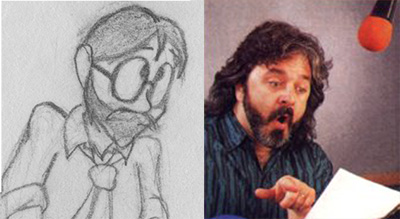
In 1997, a year before I graduated high school, I drew my first serious comic book. It was an eight page book called Small Town Showdown, and it featured the first appearances of Cassidy, Maxwell, Vincent, Clayton, Blair, and Leslie. (Clive appeared almost a year later in a comic called Flip Side.) For reasons that even I can't fully comprehend, I used an old publicity photo of Jim Cummings as the model for Vincent. As the years went on, Jim and Vincent both changed in appearance. Perhaps the only common features remaining are the wide noses and some fly-away hair (although Vincent's hair is much messier now.)

Early version of Vincent and the photo I borrowed for reference


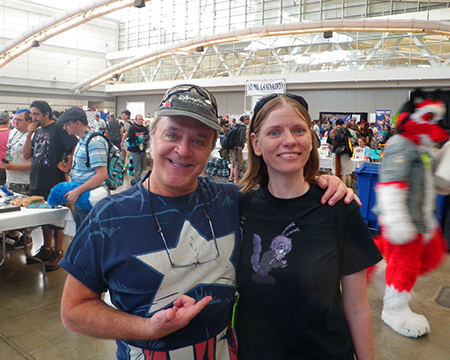
Of course, teenage me could never imagine Jim Cummings ever, ever, ever finding out about this. But adult me, who was trying to think of a way to tell Mr. Cummings how much he has meant to me, I couldn't think of any other story to tell. So, I thought up an "elevator pitch" version of the events listed above, wrote it on the back of an Urban Underbrush postcard (yes, I have those) and brought it with me to present to Mr. Cummings at the convention. I usually don't get nervous at these things anymore (heck, I once sang karaoke in front of the National Cartoonist Society) but in that autograph line, I was feeling anxiety like I hadn't felt in years. Finally, when my turn came, I awkwardly told Jim my story and handed him my postcard. Jim thanked me graciously and shook my hand. Then he changed his mind about ending with a handshake and gave me a hug. And here, I had been thinking a handshake was too much to hope for.

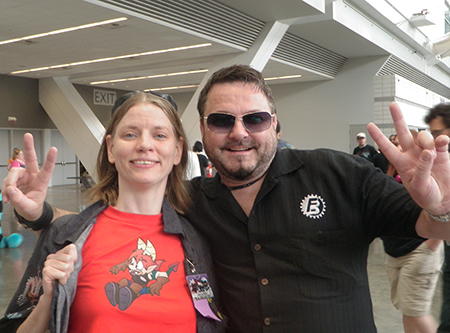
That's Jim on the left and me on the right, in case you were confused.


In the afternoon/evening, I attended all of the voice actor panels. Of course, both guests were funny and charming and everything was alright with the world.

The next day, things got weird.

On Saturday morning, I was ready to attend Jim Cumming's second panel (the Second Cummings) and my sister Liz came with me this time. The panel was late to get started, so, to keep the crowd busy Robert Bourke,  the moderator, asked if there were any artists in the audience who would be willing to try and draw Jim Cummings.

Liz immediately started shaking my arm and emphatically whispered "You have to do this! Everything has lead to you doing this." Then she handed me a sharpie, which she apparently produced from thin air. I expected four or five people to draw caricatures, but (surprise) I was the only person who accepted the challenge. I ran my 90 second caricature to the front of the room. The moderator thanked me and held up my drawing to the crowd and I waved and bowed while they applauded and it was all pretty funny. 

Unfortunately, they had to postpone the panel, due to the late start. Fortunately when it started up at it's new time, both Jim Cummings and Lee Tockar were able to attend together. 

Me and Lee Tockar. I'm on the left this time.

Again, it was a fun show, but just as things were wrapping up, the moderator stood up and said, "Yesterday, one of the fans drew Jim's portrait and we wanted to present it to him." And he carefully produced my increasingly sketchy-looking drawing and passed it to Jim. Then the moderator asked, "The person who drew this, is she here?" And I had to stand up. And everyone applauded. And, for the briefest of seconds, the world stopped spinning.

As I recall those moments went something like this:

Jim: Thank you. You drew this?

Me: Yeah, I, sort of gave you some art on Friday too.

Jim: I remember.

Me: I suppose I'm your regular portrait artist now.

Jim: I suppose you are.

Lee: I get one of those too, right?

Me: Sure.

(The panel continues while I sketch Lee Tockar)

In the days that followed, I've told that story to friends, relatives, grocery store check-out clerks, people at the bus stop (which was weird, as I never actually took a bus anywhere) and anyone else I've encountered. And it still doesn't seem real. Because this is not the kind of thing that actually happens to people. This is the kind of thing that happens to people in self-indulgent Mary Sue daydream fantasies that we make up to amuse themselves while the wait in line to glimpse our heroes in panels or autograph sessions. We never expect these things to happen.

But, sometimes they do.

-Marj

Sunday, June 29, 2014

Crash and Consequences

So here's how it is:

Thanks to some computer trouble, Draconis Wicked is going to have to take a short break. However, starting next week (Monday, July 7) Urban Underbrush will update on Mondays and Thursdays until Draconis returns on August 4.

Or, if you ever wanted to write a guest comic to help me get back on track, I probably wouldn't say "no" to one of those.

That should be all the info you need, but if you're interested in the long version, read below:


I've been busy lately, but it's been a good kind of busy. In addition to making comics, I've been preparing to teach my annual summer art classes, getting ready for a big family wedding, and making some art for one of the auctions at Anthrocon (Pittsburgh's Furry Convention). Not an impossible amount of work, but a fuller plate than I'm used to.

Still, this has been one of the worst times for computer trouble. So imagine my surprise when my computer started running slow and wouldn't open all of my art programs. When restarts, advice from online forums, and voodoo failed to fix it, I took my computer back to the store where it was quickly diagnosed with failing hard drive sensors. It's kind of like my hard drive had a terminal illness. It was going to gradually work less and less until it stopped altogether. (At least it gave me some warning so I could back up all my data.) To complicate things even further, my computer was a custom model, built to my specifications, which meant that it took the Apple Store five days to get the special parts they needed to replace the malfunctioning pieces. (At least it's still under warranty.)

If that wasn't enough, my printer/scanner seemed to have some kind of suicide pact with my hard drive, because it promptly stopped working forever as soon as the hard drive glitch was discovered.

Now this Murphy's Law-proving technology incident is finally getting resolved, but I'm still about to start teaching my two-week computer art class and I've been unable to create a buffer of comics to get me through those weeks, as I've done every other summer.

I've looked at this problem from every possible angle, and the only solution seems to be that I stop production of Draconis Wicked comics until summer classes are over, then give myself another two weeks to get caught up again.

However I can ramp up production of Urban Underbrush comics and fill the void. This is possible because:

  1. Urban Underbrush is much quicker to color than Draconis Wicked.
  2. Urban Underbrush already has a buffer of comics stashed away, as I was able to keep working on Underbrush, even when the computer was failing.
While we wait for Draconis to come back, I'll try to keep posting about all the other wonderful stuff I've been up to that's been helping to make this situation so difficult.

Management appreciates your cooperation. 

-Marj

Tuesday, April 15, 2014

Comic "Stripped," Part Two: My Response

In my last blog entry, I reviewed Stripped a documentary on comic strips by cartoonist/film maker, Dave Kellett, and cinematographer, Fred Schroeder.

As I had mentioned previously, I’ve decided to write two responses to Stripped, a straightforward review, and a personal response. This is part two.

I have a lot of respect for Dave Kellett. His comic strip, Sheldon, was the first webcomic I ever followed (I believe I picked it up around 2005). So in 2011, when Dave announced that he would be making a documentary on comic strips, I was intrigued. I followed the project on twitter and threw in a few bucks for the Kickstarter campaign. I even shared the project on Facebook, Twitter, and on my blog (for whatever that was worth.)

As other followers and supporters of Stripped already know, the documentary was supposed to take only a year or two to complete. It was also supposed to be a much simpler project. But, as I’ve said before, sometimes the worst enemy to a good idea is a better idea. And as Dave and Fred gained more support, they quickly realized that they could surpass their original vision and build something truly remarkable. But it would take a lot more work and little more time. Being such good community builders, as well as conscientious businessmen, Dave and Fred promptly informed their followers that the projected deadline for Stripped’s release was being pushed back in order to make a better product. They were so professional and non-flaky about the delay that I can’t imagine anyone felt offended by the decision.

Personally, I am very grateful for the delay. Because while I was following the film’s progress in the abstract, cloudy realm of social media, I was also out in the real world, learning and having experiences. And these experiences would make Stripped much, much dearer to me.

First of all, while Stripped was being made, I learned a bit about filmmaking. Back in 2011, I was making a few animated shorts, partly to show my animation students and partly to satisfy my own artistic interests. I was also doing some film editing and archiving for my job as a technology assistant at a university. Of course, comparing my projects to an independent film is a bit like comparing a grocery list to a best-selling novel. But my own little experiences gave me an idea of how a cartoonist’s skill set and a filmmaker’s skill set could fit together.

Then my sister, Liz, got involved with an indy film in the area. I had very little to do with her job, aside from lending her some props and helping her dye a few costumes to the perfect shade of imitation filth. But from the few projects I assisted with, and mostly from Liz’s stories, I learned just how hard it is to make a movie, especially when you’re a small studio. When Stripped began I remember one of the directors tweeting this bit of trivia: only one in five indy film projects is ever completed. I was amazed that the number was so small. How could people start a project so labor intensive and not finish? How could they just waste whatever time, money, and passion they had already spent? But, by the time Liz’s job was over, and I had a better understanding of the process, I was amazed that as many as one in five films were finished. And my admiration of Stripped grew.

Also, while Stripped was still in progress, I got to meet a number of cartoonists who would be featured in the film. I met Stephan Pastis when he gave a lecture at the Pittsburgh Toonseum. I ran into Shaenon Garrity at a karaoke party the night before the 2013 Rueben Awards. Two days later, I talked to almost a dozen more Stripped cartoonists at the Pittsburgh Comic Arts Festival. (I still treasure that turtle Patrick McDonnell drew in honor of my Noko.) Many of these cartoonists even asked me about my own work. Some of them gave me autographs and sketches. One of them may have called me “sexy” (It was Dan Piraro and he probably says that to all the ladies. ...still…)

Aside from the artists I met in person over the years, I can’t even count the number of featured cartoonists who occasionally responded to me on twitter on in message boards.

I didn’t even notice how many of these little experiences – these brushes with famous people – I had accumulated until I saw Stripped. Suddenly, so many faces looked familiar. Instead of watching the interviews and thinking, “So that’s what that guy looks like.” I was thinking,“Hey, I remember that guy.” At this point I was feeling so involved, I was starting to feel like a part of the movie.

Then, quite unexpectedly, I was a part of the movie.

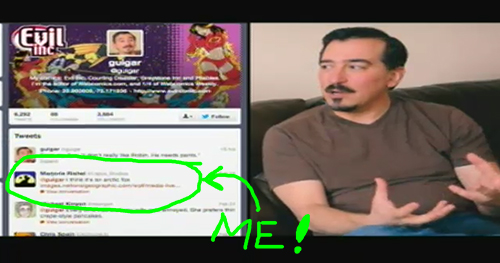
In Chapter Seven of Stripped, there’s a neat little discussion about how cartoonists use social media to interact with their audiences. To illustrate that concept, the documentary shows a screen capture of Brad Guigar’s twitter feed. And they just happened to have taken that image from a day when I responded to one of Brad’s tweets. So, in that screen cap, you can very clearly see my full name and the Lepus Studios logo (my twitter avatar) in the actual movie.

You can spot this at exactly 56 minutes into the film.


When I first saw my own name and artwork on the screen, it didn’t quite sink in right away. A part of my brain was saying “It’s a tweet from you on a screen. You see this all the time.” But then, another part of my brain was saying, “No, this time it’s different and it's more important. Wake up and figure out why is this is different.” Then it sunk in. I was a part of Stripped. I don’t want to get too egotistical about my accidental inclusion. It’s a bit like being an extra in a movie. It’s cool to see yourself there, but you have no delusions about being a star. Still, this documentary is monumental and I am honored to have been included in some small way.

Over the years, it was very cool to watch the making of Stripped and to have been given the opportunity to watch it's journey along side my own journeys as a cartoonist. For me, one of the most inspiring moments of the film was when Bill Watterson points out that an audience doesn’t need to give an artist it’s time, so the artist must reward it’s audience for whatever time is given.


Between 2011 and now, plus the time spent actually watching the film, any time I gave Stripped was time well spent.

-Marjorie Rishel
  www.lepusstudios.com

Tuesday, April 8, 2014

Comic "Stripped," Part One: The Review

Last week, I finally saw Stripped, a documentary on comic strips by cartoonist/film maker, Dave Kellett, and cinematographer, Fred Schroeder.

While drafting this blog, I discovered that I have too much to say for a single blog entry, so I’m splitting my response to Stripped into two parts: My review of the film and my personal response. This is part one. Look for part two later this week.

The Review

Like many of you, I had been looking forward to Stripped for a long time. Some of you may even remember the “signal boosting” blog I wrote for the film back in 2011, when it was still crowdsourcing on Kickstarter.

I’m pleased to tell you that Stripped has been worth the wait and worth the hype. The self-proclaimed “love letter to comics” has something for everyone from die-hard comic fans to casual readers.

If you’re worried that this will be a dry documentary, cast those fears aside. Not counting the credit reel, the film runs about an hour and fifteen minutes - not too long and not too short. And all the while, it keeps viewers engaged and entertained with music, graphics and animations.

Stripped tells the story of comic strips: what they have been, what they are, and where they might be going. Along they way, famous creators like Jim Davis, Cathy Guisewite, Jeff Keane, Greg Evans, Stephan Pastis, Scott Kurtz and even Bill Watterson tell their stories.

Organizing this movie must have been a challenge. Obviously, it makes sense to tell the story of comics in chronological order, but some topics fit more neatly into the timeline than others. Ultimately, the directors settled on breaking the documentary into eight parts.

The Opening: A light-hearted beginning that describes comics and their significance.

Everybody Loves Comics: The introduction leads very naturally into this second segment, in which many of the featured cartoonists reminisce about their earliest memories of reading and sharing comics.

The Golden Age of Comics: Soon, we get into comic strip history. We learn about the great popularity of comics in the 60’s, 70’s and 80’s.

Picking up the Pencil: A few personal stories about how some cartoonists started drawing and how they broke into the business. Plus we get to learn a little about how the newspaper biz and syndication work.

The Creative Process: The challenges of staying creative and turning daily comics into a long-term career.

The Crisis: What happens to comics as newspaper sales dwindle?

The Digital Revolution: New technology creates new opportunities. We look at the emergence of webcomics, learn about the webcomic business model, and discuss the pros and cons of web publishing vs. print publishing.

The Future: No one knows what the future will bring but we have some ideas. All of them include comics.

The structure of the film is deceptively simple. But, just like a comic strip can fit a lot of creativity and depth into a couple of panels, Kellett and Schroeder fit a lot of valuable content into those eight parts. Bill Watterson’s advice to cartoonists is invaluable. Darrin Bell tells a story about selling and African-American comic to old-fashioned syndicates that surprised me more than it should have. Jerry Holkins and Mike Krahulik tell tales of starting webcomics during/after the “dot-com” boom that take me right back to the 90’s.

And all the while, the film masterfully manages to look sharp, polished, credible and completely professional, while still looking fun, engaging and a bit laid-back. The little sketches, title cards for chapters, and little notes and jokes in the DVD menus and credits are so distinctly Dave Kellett’s style, yet they fit the universality of the film so well.

Here’s the website again, for those of you who missed it the first time: http://www.strippedfilm.com/

I would recommend Stripped to anyone who likes comics. And to anyone who loves comics, I would probably have to recommend it twice.

-Marj

Tuesday, April 1, 2014

How I Met Your Series Finale

Last night, I watched the much-anticipated series finale to How I Met Your Mother. (For those of you who haven’t seen it yet, I’ll warn you before I start the spoiler filled part of the blog.)

I write a lot about cartoons, comics, and occasionally movies. So me writing about romantic comedy sitcom may seem a little unexpected. I actually got into How I Met Your Mother through webcomics. As some of you know, HIMYM writer/co-producer Gloria Calderon Kellet is the wife of popular webcartoonist Dave Kellet, who creates the comics Sheldon and Drive. Sheldon was the first webcomic I ever followed and Dave’s blog endorsed his wife’s work often enough that I decided to give it a chance.

By the way, Dave Kellet just finished a major project of his own, a documentary on comic strips titled Stripped. (I am still waiting for my DVD to arrive, but once I see the documentary, I promise to review it in excruciating detail and geek out appropriately.) Anyway, with both the husband and wife both completing and promoting major projects at roughly the same time, I do not understand how the Kellet household has not imploded. Everyone in that family has earned my respect for getting through this situation with so much class.

How I Met Your Mother  actually used a lot of the same devices as comic strips. The same types of jokes, running gags, and visual humor made the comic/cartoon influences look pretty clear to me. There are even some rewards for people who follow both Dave's and Gloria's work. For example, in HIMYM, did you ever notice that every time a male extra needed a name, he would inevitable be called “Arthur,” (the same name as Sheldon’s pet duck?) This also explains why ducks won the “Ducks vs. Rabbits” debate, when everyone knows that rabbits are better. Sometimes, stories from HIMYM some suspiciously like real-life anecdotes I previously read on cartoonist blogs. For example, the episode where Marshall’s obnoxious co-workers tease him when they find a love note from his wife sounds suspiciously like that real-life story from Scott Kurtz’s blog, where Scott teased Dave for taking a Skype call from his wife and daughter while attending a comic con. Sure, most sitcom writers borrow funny incidents from their real lives, but thanks to the internet, we’re interconnected enough to hear these tales from more than one of the people involved. My sister, Emily once joked, “So, you’re watching one of the most popular sitcoms on television to selectively stalk a small group of people?” I’m not really as creepy as it sounds (maybe 30% that creepy, tops.) I just have a weird memory for certain details and I have one of those brains that locks on patterns. I’ll get back to that in a bit.

SPOILER ALERT: I’m about to get into detail about How I Met Your Mother, the series and the finale, so if you haven’t watched it yet, go away and don’t come back until you do.


You’re still here? You either saw the whole series or you don’t really care about spoilers. Well, listen up, everything about this show tells us that the whole thing builds to the last episode, so if you haven’t seen it yet, you better be CERTAIN that you won’t ever want to watch it before you keep reading beyond this point.


______________________________________________


The How I Met Your Mother series finale has met with some mixed reviews. The biggest disappointment was that the main character, Ted and his long sought wife, Tracy, did NOT get to live happily ever after. Part of the twist ending was that they only had about a decade together before Tracy became terminally ill. Ted explains to his children that his long search to find their mother was necessary, because it made him cherish every moment of their time together. This was unexpectedly bittersweet for such an upbeat sitcom. We wanted to see Ted and Tracy live happily ever after. That was the ending we wanted.

But not the ending we deserved.

At a glance, this ending may seem like something the writers could have come up with at any time, but on examination, this was clearly the ending they were building to right from the start. Come on, every scene with Ted’s kids was filmed back when the series began in 2005 (how else could those kids have stayed teenagers for all these years?).

But there’s another indication that this ending was planned from the beginning, and this is where the writing is at it most brilliant. I mentioned earlier that my brain wants to find patterns in things and there is a strong pattern in way this series was written. The first episode is a map of the entire series, specifically Ted and Robin’s relationship.

Let’s recap the series so we can examine this pattern.

Episode One begins in the year 2030 and fifty-two year-old Ted sits down with his two teenage children and asks, “Did I ever tell you the story about how I met your mother?” Ted proceeds to tell the story, starting in 2005, on the day his two best friends got engaged. The engagement prompts Ted to think seriously about love and marriage for the first time in his life. Later, Ted meets a woman named Robin. He thinks she could be the love of his life. They go on a sweet-but-awkward first date. Ted later decides that the date ended too abruptly, so he goes back to her apartment to make a big romantic gesture, which Robin considers sweet but overwhelming. After all, they haven’t known each other long enough for Ted to declare his love for her. The episode ends with fifty-two year-old Ted telling his children, “And that was how I met your Aunt Robin … Hang on, kids, it’s a long story.” This was the first plot twist. The story leads us to believe Robin and Ted will end up together, then reveals that Ted will actually marry someone else.

The next eight years of the series show how Robin joins Ted’s group of best friends and we watch them navigate life. Marshall and Lily deal with marriage and family. Barney stay a confirmed bachelor and philanderer, but gradually considers settling down. Ted and Robin mostly remain friends, but sort of have some on-again, off-again relationships. But Ted and Robin want different things out of life: Ted wants a family and Robin wants a career in journalism. Can they make a relationship work despite their differences, or is their imperfect love for each other holding them back from finding their real love and happiness? Because of the first episode, the audience knows the answer, or at least, it thinks it does. In the final season, Robin does not choose Ted, but marries Barney instead. Then, Ted meets his wife-to-be, Tracy, at Barney and Robin’s wedding, leading the viewers to believe that the purpose of Ted and Robin’s relationship was to guide Ted to the real love of his life.

The final episode compresses the next seventeen years into a relatively short one-hour show. Ted and Tracy enjoy a perfect relationship. Robin and Barney are happily married for a while, but end up separating after three years. Robin leaves the circle of friends, partly because work keeps her busy, partly because she doesn’t want to hang around her ex-husband, and partly because being around Ted makes Robin wonder if she should have chosen him when she had the chance. Ted’s wife passes away in 2024 and Ted concludes telling the tale to his son and daughter. 

BUT THEN, Ted’s children don’t believe that the story was only about their mother. Instead, they suspect that their father has been telling this story to explain why he’s in love with Robin. His children urge him to find Robin and be happy. The series ends with Ted outside Robin’s apartment recreating a moment from their first date, back in Episode One.

Do you see the pattern that the pilot episode sets up for us? The first episode leads us to believe that Ted and Robin will end up together, then the last minute tells us, no - Ted will end up with someone else. Then the entire rest of the series recreates that trick for the next nine years, as we are kept believing that Ted and Robin will never be together, until the last five minutes of the entire series flips our expectations. Again.

Heck, Ted and Robin’s first date is a road map to their whole relationship. They go out, and have a good time with some ups and downs. This part of the evening represents the bulk of the series - their eight years together. Then Ted goes home too soon, representing the years Robin spent distancing herself from her old friends. Finally, Ted comes back to declare his love and win Robin’s heart, which obviously represents the same event Ted recreates in the series finale. When Ted made that gesture in 2005, everyone told him it was “too soon.” While everyone meat “it’s too soon in the relationship to get so personal,” it’s actually “too soon” in Ted and Robin’s lives. They have to wait twenty-five years until they’ve accomplished all their conflicting dreams before they can be together.

“But what about Tracy? I liked Tracy. Why should she be sacrificed so we could have this ending?” I haven’t read too many responses to the series finale, but these seem to be the most common complaints. Of course we liked Tracy. We had to like Tracy. If Tracy wasn’t Ted’s true love, then all the time he spent waiting for Robin would just seem like a waste. Ted had two great loves in his life. And, just to keep it fair, Ted was already the second great love of Tracy’s life. She once had a perfect boyfriend named Max, who would probably have been her husband if he hadn’t died in an accident eight years earlier.

Sure, a “they all lived happily ever after” ending probably would have made me happier, but it would never have been as good. It’s impossible to look back without seeing that this is the way the story was meant to end. And the fact that they implied the whole thing right from the start is crazy genius. I think a lot of people didn’t get it simply because they just weren’t expecting this kind of cleverness from a TV sitcom.

Farewell to another good TV show. A series that well planned is certainly a rare thing indeed.

-Marj