Sunday, June 29, 2014

Crash and Consequences

So here's how it is:

Thanks to some computer trouble, Draconis Wicked is going to have to take a short break. However, starting next week (Monday, July 7) Urban Underbrush will update on Mondays and Thursdays until Draconis returns on August 4.

Or, if you ever wanted to write a guest comic to help me get back on track, I probably wouldn't say "no" to one of those.

That should be all the info you need, but if you're interested in the long version, read below:


I've been busy lately, but it's been a good kind of busy. In addition to making comics, I've been preparing to teach my annual summer art classes, getting ready for a big family wedding, and making some art for one of the auctions at Anthrocon (Pittsburgh's Furry Convention). Not an impossible amount of work, but a fuller plate than I'm used to.

Still, this has been one of the worst times for computer trouble. So imagine my surprise when my computer started running slow and wouldn't open all of my art programs. When restarts, advice from online forums, and voodoo failed to fix it, I took my computer back to the store where it was quickly diagnosed with failing hard drive sensors. It's kind of like my hard drive had a terminal illness. It was going to gradually work less and less until it stopped altogether. (At least it gave me some warning so I could back up all my data.) To complicate things even further, my computer was a custom model, built to my specifications, which meant that it took the Apple Store five days to get the special parts they needed to replace the malfunctioning pieces. (At least it's still under warranty.)

If that wasn't enough, my printer/scanner seemed to have some kind of suicide pact with my hard drive, because it promptly stopped working forever as soon as the hard drive glitch was discovered.

Now this Murphy's Law-proving technology incident is finally getting resolved, but I'm still about to start teaching my two-week computer art class and I've been unable to create a buffer of comics to get me through those weeks, as I've done every other summer.

I've looked at this problem from every possible angle, and the only solution seems to be that I stop production of Draconis Wicked comics until summer classes are over, then give myself another two weeks to get caught up again.

However I can ramp up production of Urban Underbrush comics and fill the void. This is possible because:

  1. Urban Underbrush is much quicker to color than Draconis Wicked.
  2. Urban Underbrush already has a buffer of comics stashed away, as I was able to keep working on Underbrush, even when the computer was failing.
While we wait for Draconis to come back, I'll try to keep posting about all the other wonderful stuff I've been up to that's been helping to make this situation so difficult.

Management appreciates your cooperation. 

-Marj

Tuesday, April 15, 2014

Comic "Stripped," Part Two: My Response

In my last blog entry, I reviewed Stripped a documentary on comic strips by cartoonist/film maker, Dave Kellett, and cinematographer, Fred Schroeder.

As I had mentioned previously, I’ve decided to write two responses to Stripped, a straightforward review, and a personal response. This is part two.

I have a lot of respect for Dave Kellett. His comic strip, Sheldon, was the first webcomic I ever followed (I believe I picked it up around 2005). So in 2011, when Dave announced that he would be making a documentary on comic strips, I was intrigued. I followed the project on twitter and threw in a few bucks for the Kickstarter campaign. I even shared the project on Facebook, Twitter, and on my blog (for whatever that was worth.)

As other followers and supporters of Stripped already know, the documentary was supposed to take only a year or two to complete. It was also supposed to be a much simpler project. But, as I’ve said before, sometimes the worst enemy to a good idea is a better idea. And as Dave and Fred gained more support, they quickly realized that they could surpass their original vision and build something truly remarkable. But it would take a lot more work and little more time. Being such good community builders, as well as conscientious businessmen, Dave and Fred promptly informed their followers that the projected deadline for Stripped’s release was being pushed back in order to make a better product. They were so professional and non-flaky about the delay that I can’t imagine anyone felt offended by the decision.

Personally, I am very grateful for the delay. Because while I was following the film’s progress in the abstract, cloudy realm of social media, I was also out in the real world, learning and having experiences. And these experiences would make Stripped much, much dearer to me.

First of all, while Stripped was being made, I learned a bit about filmmaking. Back in 2011, I was making a few animated shorts, partly to show my animation students and partly to satisfy my own artistic interests. I was also doing some film editing and archiving for my job as a technology assistant at a university. Of course, comparing my projects to an independent film is a bit like comparing a grocery list to a best-selling novel. But my own little experiences gave me an idea of how a cartoonist’s skill set and a filmmaker’s skill set could fit together.

Then my sister, Liz, got involved with an indy film in the area. I had very little to do with her job, aside from lending her some props and helping her dye a few costumes to the perfect shade of imitation filth. But from the few projects I assisted with, and mostly from Liz’s stories, I learned just how hard it is to make a movie, especially when you’re a small studio. When Stripped began I remember one of the directors tweeting this bit of trivia: only one in five indy film projects is ever completed. I was amazed that the number was so small. How could people start a project so labor intensive and not finish? How could they just waste whatever time, money, and passion they had already spent? But, by the time Liz’s job was over, and I had a better understanding of the process, I was amazed that as many as one in five films were finished. And my admiration of Stripped grew.

Also, while Stripped was still in progress, I got to meet a number of cartoonists who would be featured in the film. I met Stephan Pastis when he gave a lecture at the Pittsburgh Toonseum. I ran into Shaenon Garrity at a karaoke party the night before the 2013 Rueben Awards. Two days later, I talked to almost a dozen more Stripped cartoonists at the Pittsburgh Comic Arts Festival. (I still treasure that turtle Patrick McDonnell drew in honor of my Noko.) Many of these cartoonists even asked me about my own work. Some of them gave me autographs and sketches. One of them may have called me “sexy” (It was Dan Piraro and he probably says that to all the ladies. ...still…)

Aside from the artists I met in person over the years, I can’t even count the number of featured cartoonists who occasionally responded to me on twitter on in message boards.

I didn’t even notice how many of these little experiences – these brushes with famous people – I had accumulated until I saw Stripped. Suddenly, so many faces looked familiar. Instead of watching the interviews and thinking, “So that’s what that guy looks like.” I was thinking,“Hey, I remember that guy.” At this point I was feeling so involved, I was starting to feel like a part of the movie.

Then, quite unexpectedly, I was a part of the movie.

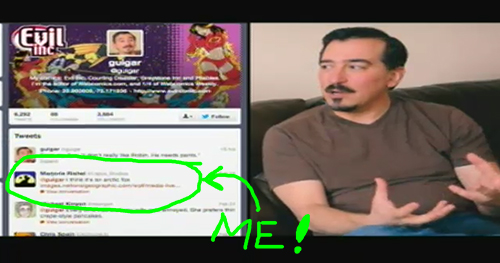
In Chapter Seven of Stripped, there’s a neat little discussion about how cartoonists use social media to interact with their audiences. To illustrate that concept, the documentary shows a screen capture of Brad Guigar’s twitter feed. And they just happened to have taken that image from a day when I responded to one of Brad’s tweets. So, in that screen cap, you can very clearly see my full name and the Lepus Studios logo (my twitter avatar) in the actual movie.

You can spot this at exactly 56 minutes into the film.


When I first saw my own name and artwork on the screen, it didn’t quite sink in right away. A part of my brain was saying “It’s a tweet from you on a screen. You see this all the time.” But then, another part of my brain was saying, “No, this time it’s different and it's more important. Wake up and figure out why is this is different.” Then it sunk in. I was a part of Stripped. I don’t want to get too egotistical about my accidental inclusion. It’s a bit like being an extra in a movie. It’s cool to see yourself there, but you have no delusions about being a star. Still, this documentary is monumental and I am honored to have been included in some small way.

Over the years, it was very cool to watch the making of Stripped and to have been given the opportunity to watch it's journey along side my own journeys as a cartoonist. For me, one of the most inspiring moments of the film was when Bill Watterson points out that an audience doesn’t need to give an artist it’s time, so the artist must reward it’s audience for whatever time is given.


Between 2011 and now, plus the time spent actually watching the film, any time I gave Stripped was time well spent.

-Marjorie Rishel
  www.lepusstudios.com

Tuesday, April 8, 2014

Comic "Stripped," Part One: The Review

Last week, I finally saw Stripped, a documentary on comic strips by cartoonist/film maker, Dave Kellett, and cinematographer, Fred Schroeder.

While drafting this blog, I discovered that I have too much to say for a single blog entry, so I’m splitting my response to Stripped into two parts: My review of the film and my personal response. This is part one. Look for part two later this week.

The Review

Like many of you, I had been looking forward to Stripped for a long time. Some of you may even remember the “signal boosting” blog I wrote for the film back in 2011, when it was still crowdsourcing on Kickstarter.

I’m pleased to tell you that Stripped has been worth the wait and worth the hype. The self-proclaimed “love letter to comics” has something for everyone from die-hard comic fans to casual readers.

If you’re worried that this will be a dry documentary, cast those fears aside. Not counting the credit reel, the film runs about an hour and fifteen minutes - not too long and not too short. And all the while, it keeps viewers engaged and entertained with music, graphics and animations.

Stripped tells the story of comic strips: what they have been, what they are, and where they might be going. Along they way, famous creators like Jim Davis, Cathy Guisewite, Jeff Keane, Greg Evans, Stephan Pastis, Scott Kurtz and even Bill Watterson tell their stories.

Organizing this movie must have been a challenge. Obviously, it makes sense to tell the story of comics in chronological order, but some topics fit more neatly into the timeline than others. Ultimately, the directors settled on breaking the documentary into eight parts.

The Opening: A light-hearted beginning that describes comics and their significance.

Everybody Loves Comics: The introduction leads very naturally into this second segment, in which many of the featured cartoonists reminisce about their earliest memories of reading and sharing comics.

The Golden Age of Comics: Soon, we get into comic strip history. We learn about the great popularity of comics in the 60’s, 70’s and 80’s.

Picking up the Pencil: A few personal stories about how some cartoonists started drawing and how they broke into the business. Plus we get to learn a little about how the newspaper biz and syndication work.

The Creative Process: The challenges of staying creative and turning daily comics into a long-term career.

The Crisis: What happens to comics as newspaper sales dwindle?

The Digital Revolution: New technology creates new opportunities. We look at the emergence of webcomics, learn about the webcomic business model, and discuss the pros and cons of web publishing vs. print publishing.

The Future: No one knows what the future will bring but we have some ideas. All of them include comics.

The structure of the film is deceptively simple. But, just like a comic strip can fit a lot of creativity and depth into a couple of panels, Kellett and Schroeder fit a lot of valuable content into those eight parts. Bill Watterson’s advice to cartoonists is invaluable. Darrin Bell tells a story about selling and African-American comic to old-fashioned syndicates that surprised me more than it should have. Jerry Holkins and Mike Krahulik tell tales of starting webcomics during/after the “dot-com” boom that take me right back to the 90’s.

And all the while, the film masterfully manages to look sharp, polished, credible and completely professional, while still looking fun, engaging and a bit laid-back. The little sketches, title cards for chapters, and little notes and jokes in the DVD menus and credits are so distinctly Dave Kellett’s style, yet they fit the universality of the film so well.

Here’s the website again, for those of you who missed it the first time: http://www.strippedfilm.com/

I would recommend Stripped to anyone who likes comics. And to anyone who loves comics, I would probably have to recommend it twice.

-Marj

Tuesday, April 1, 2014

How I Met Your Series Finale

Last night, I watched the much-anticipated series finale to How I Met Your Mother. (For those of you who haven’t seen it yet, I’ll warn you before I start the spoiler filled part of the blog.)

I write a lot about cartoons, comics, and occasionally movies. So me writing about romantic comedy sitcom may seem a little unexpected. I actually got into How I Met Your Mother through webcomics. As some of you know, HIMYM writer/co-producer Gloria Calderon Kellet is the wife of popular webcartoonist Dave Kellet, who creates the comics Sheldon and Drive. Sheldon was the first webcomic I ever followed and Dave’s blog endorsed his wife’s work often enough that I decided to give it a chance.

By the way, Dave Kellet just finished a major project of his own, a documentary on comic strips titled Stripped. (I am still waiting for my DVD to arrive, but once I see the documentary, I promise to review it in excruciating detail and geek out appropriately.) Anyway, with both the husband and wife both completing and promoting major projects at roughly the same time, I do not understand how the Kellet household has not imploded. Everyone in that family has earned my respect for getting through this situation with so much class.

How I Met Your Mother  actually used a lot of the same devices as comic strips. The same types of jokes, running gags, and visual humor made the comic/cartoon influences look pretty clear to me. There are even some rewards for people who follow both Dave's and Gloria's work. For example, in HIMYM, did you ever notice that every time a male extra needed a name, he would inevitable be called “Arthur,” (the same name as Sheldon’s pet duck?) This also explains why ducks won the “Ducks vs. Rabbits” debate, when everyone knows that rabbits are better. Sometimes, stories from HIMYM some suspiciously like real-life anecdotes I previously read on cartoonist blogs. For example, the episode where Marshall’s obnoxious co-workers tease him when they find a love note from his wife sounds suspiciously like that real-life story from Scott Kurtz’s blog, where Scott teased Dave for taking a Skype call from his wife and daughter while attending a comic con. Sure, most sitcom writers borrow funny incidents from their real lives, but thanks to the internet, we’re interconnected enough to hear these tales from more than one of the people involved. My sister, Emily once joked, “So, you’re watching one of the most popular sitcoms on television to selectively stalk a small group of people?” I’m not really as creepy as it sounds (maybe 30% that creepy, tops.) I just have a weird memory for certain details and I have one of those brains that locks on patterns. I’ll get back to that in a bit.

SPOILER ALERT: I’m about to get into detail about How I Met Your Mother, the series and the finale, so if you haven’t watched it yet, go away and don’t come back until you do.


You’re still here? You either saw the whole series or you don’t really care about spoilers. Well, listen up, everything about this show tells us that the whole thing builds to the last episode, so if you haven’t seen it yet, you better be CERTAIN that you won’t ever want to watch it before you keep reading beyond this point.


______________________________________________


The How I Met Your Mother series finale has met with some mixed reviews. The biggest disappointment was that the main character, Ted and his long sought wife, Tracy, did NOT get to live happily ever after. Part of the twist ending was that they only had about a decade together before Tracy became terminally ill. Ted explains to his children that his long search to find their mother was necessary, because it made him cherish every moment of their time together. This was unexpectedly bittersweet for such an upbeat sitcom. We wanted to see Ted and Tracy live happily ever after. That was the ending we wanted.

But not the ending we deserved.

At a glance, this ending may seem like something the writers could have come up with at any time, but on examination, this was clearly the ending they were building to right from the start. Come on, every scene with Ted’s kids was filmed back when the series began in 2005 (how else could those kids have stayed teenagers for all these years?).

But there’s another indication that this ending was planned from the beginning, and this is where the writing is at it most brilliant. I mentioned earlier that my brain wants to find patterns in things and there is a strong pattern in way this series was written. The first episode is a map of the entire series, specifically Ted and Robin’s relationship.

Let’s recap the series so we can examine this pattern.

Episode One begins in the year 2030 and fifty-two year-old Ted sits down with his two teenage children and asks, “Did I ever tell you the story about how I met your mother?” Ted proceeds to tell the story, starting in 2005, on the day his two best friends got engaged. The engagement prompts Ted to think seriously about love and marriage for the first time in his life. Later, Ted meets a woman named Robin. He thinks she could be the love of his life. They go on a sweet-but-awkward first date. Ted later decides that the date ended too abruptly, so he goes back to her apartment to make a big romantic gesture, which Robin considers sweet but overwhelming. After all, they haven’t known each other long enough for Ted to declare his love for her. The episode ends with fifty-two year-old Ted telling his children, “And that was how I met your Aunt Robin … Hang on, kids, it’s a long story.” This was the first plot twist. The story leads us to believe Robin and Ted will end up together, then reveals that Ted will actually marry someone else.

The next eight years of the series show how Robin joins Ted’s group of best friends and we watch them navigate life. Marshall and Lily deal with marriage and family. Barney stay a confirmed bachelor and philanderer, but gradually considers settling down. Ted and Robin mostly remain friends, but sort of have some on-again, off-again relationships. But Ted and Robin want different things out of life: Ted wants a family and Robin wants a career in journalism. Can they make a relationship work despite their differences, or is their imperfect love for each other holding them back from finding their real love and happiness? Because of the first episode, the audience knows the answer, or at least, it thinks it does. In the final season, Robin does not choose Ted, but marries Barney instead. Then, Ted meets his wife-to-be, Tracy, at Barney and Robin’s wedding, leading the viewers to believe that the purpose of Ted and Robin’s relationship was to guide Ted to the real love of his life.

The final episode compresses the next seventeen years into a relatively short one-hour show. Ted and Tracy enjoy a perfect relationship. Robin and Barney are happily married for a while, but end up separating after three years. Robin leaves the circle of friends, partly because work keeps her busy, partly because she doesn’t want to hang around her ex-husband, and partly because being around Ted makes Robin wonder if she should have chosen him when she had the chance. Ted’s wife passes away in 2024 and Ted concludes telling the tale to his son and daughter. 

BUT THEN, Ted’s children don’t believe that the story was only about their mother. Instead, they suspect that their father has been telling this story to explain why he’s in love with Robin. His children urge him to find Robin and be happy. The series ends with Ted outside Robin’s apartment recreating a moment from their first date, back in Episode One.

Do you see the pattern that the pilot episode sets up for us? The first episode leads us to believe that Ted and Robin will end up together, then the last minute tells us, no - Ted will end up with someone else. Then the entire rest of the series recreates that trick for the next nine years, as we are kept believing that Ted and Robin will never be together, until the last five minutes of the entire series flips our expectations. Again.

Heck, Ted and Robin’s first date is a road map to their whole relationship. They go out, and have a good time with some ups and downs. This part of the evening represents the bulk of the series - their eight years together. Then Ted goes home too soon, representing the years Robin spent distancing herself from her old friends. Finally, Ted comes back to declare his love and win Robin’s heart, which obviously represents the same event Ted recreates in the series finale. When Ted made that gesture in 2005, everyone told him it was “too soon.” While everyone meat “it’s too soon in the relationship to get so personal,” it’s actually “too soon” in Ted and Robin’s lives. They have to wait twenty-five years until they’ve accomplished all their conflicting dreams before they can be together.

“But what about Tracy? I liked Tracy. Why should she be sacrificed so we could have this ending?” I haven’t read too many responses to the series finale, but these seem to be the most common complaints. Of course we liked Tracy. We had to like Tracy. If Tracy wasn’t Ted’s true love, then all the time he spent waiting for Robin would just seem like a waste. Ted had two great loves in his life. And, just to keep it fair, Ted was already the second great love of Tracy’s life. She once had a perfect boyfriend named Max, who would probably have been her husband if he hadn’t died in an accident eight years earlier.

Sure, a “they all lived happily ever after” ending probably would have made me happier, but it would never have been as good. It’s impossible to look back without seeing that this is the way the story was meant to end. And the fact that they implied the whole thing right from the start is crazy genius. I think a lot of people didn’t get it simply because they just weren’t expecting this kind of cleverness from a TV sitcom.

Farewell to another good TV show. A series that well planned is certainly a rare thing indeed.

-Marj


Tuesday, March 18, 2014

"Let It Go" or "My Expectations for Frozen"

Disney’s Frozen hits DVD this week. In the time between the theatrical release and the DVD release, I’ve read countless Frozen reviews and reflections. Because of some odd herd mentality, I’ve decided to post my thoughts on Frozen as well. Besides, many of my friends, relatives, and well-wishers still haven’t seen the movie yet, so this is my last chance to “preview” it for them. Please be warned, this will be a rather self-indulgent reflection, rather than an actual movie review.

Overall, I thought Frozen was a good movie. It mixed a new kind of plot with classic Disney storytelling. It was a crowd pleaser, garnered well-deserved accolades for Disney animators, and completing some work on the international versions kept my logo-designing cousin employed and out of trouble.

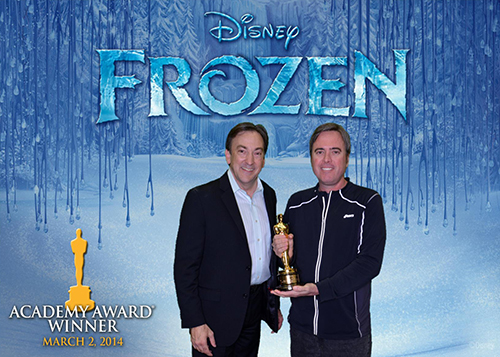
Producer Peter Del Vecho and my cousin, Brian Rishel, at the Studio's award party.

So, yeah, I liked Frozen, but I probably would have liked it more if I had known what it was about it before I watched it. The articles I read before actually seeing the movie had given me some false expectations.

I first became aware of Frozen’s existence early last fall when I read a blurb from one of the animators. This animator was discussing the challenges of working on an animation that featured “two female protagonists.” Two female protagonists? What a promising description! Princess stories have long been criticized for not including enough other female characters for the princess to relate to. Two princesses would certainly help right that wrong. Plus, while growing up, I was always very close with my own sisters, so this was a kind of relationship that I wanted to to see explored.

Unfortunately, the blurb was misleading. Frozen is not a story with “two female protagonists.” It is very much the story of Anna and her quest to save her magical sister.

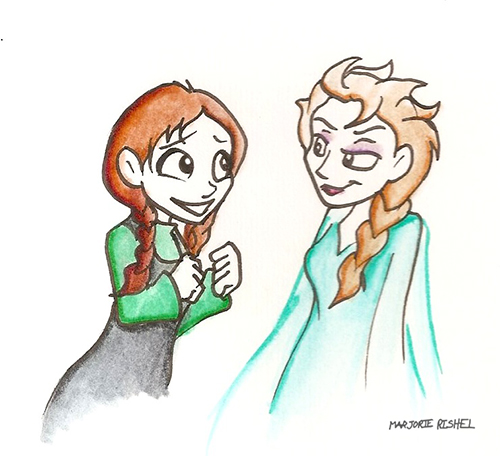
Here’s a mostly spoiler-free plot summary: Elsa and Anna are the daughters of the royal family. Elsa was born with magic powers that let her conjure ice and snow. As she grows, Elsa becomes afraid that her powers will hurt someone, especially her beloved sister, Anna. So Elsa withdraws from everyone, including Anna. Finally, when her powers become too much to conceal, Elsa exiles herself. So Anna sets out on a quest to find her sister, help her control her powers, and save the kingdom from eternal winter. Along the way, Anna finds friends to help her and, somehow, acquires two handsome suitors. So, yeah, while Elsa may be the one who puts the plot into motion and gets the best song, the story clearly follows Anna’s journey.

There’s nothing wrong with making Anna the main character. (In fact, I find it interesting that the girl without magic powers gets to be the leading lady.) But I wanted to see more of Anna and Elsa working together. That line “two female protagonists” had me holding out hope that they would team up and cooperate sometime before the big finish. While familial love and sisterhood is the heart of the story, we rarely get to see the two girls enjoying that relationship.

I sort of thought kids would get more out of Frozen if they could see more of Anna and Elsa enjoying each other’s company. When I was a kid, I loved animated Disney movies, but not all of them stayed with me. The princess stories were the most quickly forgotten because they were the least relatable. Relatable stories were the ones I wanted act out with my brother and two sisters after the movie was over. If you suspect that my brother was the one who put a stop to princess tales, you would be wrong. My sisters and I gave up on princesses before he ever had a chance to veto them. Why? Because a princess has too much power, and that makes the narrative impossible to share with other girls. The girls who didn’t get to be the princess felt stuck waiting their turn in the spotlight. Playing the princess was even worse because of the guilt that came with putting oneself so far above the other sisters. So my family gravitated towards the stories that were about teams instead.

As an adult, I could see that same scenario play out whenever my little, princess-crazed cousins would try to reenact their favorite princess tales.  As soon as the idea to play princess came up, it either turned into a battle over who gets to be Sleeping Beauty, or their was lot of awkward hemming and hawing as they tried to figure out how to tell a fairytale with multiple princesses.

I wanted little girls to see Anna and Elsa getting along so that they could incorporate the friendship into their own narratives, and, perhaps into their own lives.

But, just because Frozen didn’t meet this expectation doesn’t mean it failed. Instead of a story of cooperation, Frozen is a tale of understanding. Everyone who’s ever had a sibling knows how Anna feels when she’s waiting for Elsa to spend some time with her, as well as how Elsa feels when she can’t give Anna that time and can’t quite explain why. Frozen is not the story of how we feel when we’re together, it’s about how we feel when we’re apart and what we’ll do to be together again.


-Marjorie Rishel

Sunday, February 23, 2014

Chapter Six and Pre-Writing

You all know the old saying, "If you want to make God laugh, tell him your plans." I had a plan to post an eighteen-chapter graphic novel without missing updates to catch up on writing. See, I had written the entire script to Draconis Wicked two years before the first pages were ever drawn. I write Urban Underbrush one chapter at a time (with a few grand plans and threads secretly tying things together) but since Draconis Wicked is one story with a definite ending, it just made more sense to write the whole thing first and draw it second. This way, I could weave certain themes through the story, drop hints at what's ahead, and, of course, I'd never need to stop making new pages due to writer's block. 

As you may have noticed, I somehow managed to miss two updates in spite of all this prewriting. Shortly before I started drawing Chapter Five, I realized that I wanted to change the ending to Chapter Six. I won't give anything away, but the end of Chapter Six used a device that was interesting, but perfectly unremarkable in the Draconis world. I wanted to use this device in another story instead, where it would be a major turning point and an irreplaceable piece of the plot (more on that some other day). 

No big deal. I'd just swap the parts I wanted to save for later with similar devices and adjust the story that led up to it. Well, as soon as I took out the ending I realized that the rest of the chapter didn't work. I don't mean it didn't work without the original ending. I mean it never worked. But that big finish was distracting and interesting enough to keep me from noticing. Now that I was forced to revisit Chapter SIx without the same finale, I could see that the plot was hollow, the character personalities weren't quite right, and the whole thing seemed out of sync with the other chapters.

Members of the audience, you will never get to read Chapter Six in its original form. Never. Don't go getting curious. Reading it will only make you sad.

Rewriting Chapter Six proved difficult. I wasn't free to write whatever I felt like. Chapter Six had to accomplish certain goals, the most important one being that the end for the new Chapter Six still had to match up with the beginning of the old Chapter Seven. I found myself mentally pulling Chapter Six apart into it's basic components. I put the parts I liked in one pile and threw the rest away. It took a few passes to put the pieces back together into a unified story. Gradually, I recognized exactly which moments were holding me back and which themes I should have been exploring all along.

Now that I've finished the new script for Chapter Six, I feel like it was well worth the time and even the delays. The new Chapter Six isn't just "better than the old one," "good for a repair job," or "successfully patched all the holes." It's actually a good story. And if I've done my job, not only will you enjoy it, you won't even know that it wasn't a part of the original script.

Except I just told you.


Forget all that you read.

Marj

Sunday, February 2, 2014

Draconis Wicked - Chapter Five Retrospective

Today brought a close to Draconis Wicked Chapter Five: The Journal of Dr. Yapix.

SPOILER ALERT: Obviously, This blog will contain many references to Chapter Five and the previous chapters. If you don't want them to be spoiled, I suggest you read the comics first, then come back to the blog.

Chapter Five is one of my favorite chapters. In many ways, it sets the tone for the rest of the story. Chapter Five also gives us the last big piece of establishing information: the final destination of Draconis's journey.

If you're not sure what that means, then we should review everything that's happened so far:

Chapter One: Malcorona sends Draconis to investigate a lost treasure. Draconis learns about the Aurora Crystal and the magic barrier. He decides take the crystal for himself.

Chapter Two: Draconis goes to Phoenix Village, looking for someone he can trick into crossing the barrier for him.

Chapter Three: Draconis, Flight, and Snakey learn that no one can carry the Aurora Crystal across the barrier without absorbing its magic. They also learn about the secret passage to the treasury. Draconis decides to go out into the world and look for the passage entrance.

Chapter Four: Draconis and his crew have no idea where the entrance may be, but Chisel Town seems like a good place to start looking. They cross the Forest of Mists to get there.

Chapter Five: The mines of Chisel Town are a dead end. Instead the team finds Doctor Yapix, who figures out that the passage entrance is on the top of Mount Kyros.

As you can see, all of these early chapters are not exactly about Draconis going on his quest. They are about Draconis figuring out how to start his quest. It's sort of similar to Legend of Zelda games like A Link to the Past and Ocarina of Time. In these games, Link starts his adventure with a small quest (collecting spirit stones). When the small quest is complete (when Link gets the Master Sword), Link's real quest (the longer, tougher quest) is revealed to him. Draconis has finished his smaller quest and is now at the start of his real quest. Everything from now on will be about Draconis and his team finding a way to the top of Mount Kyros.

"Wait, how can the chapters ahead be the biggest part of the story? Can't Draconis just turn around and just walk up that Mountain?" Well, obviously, things are going to complicate this trip and Draconis won't be able to take the straightest path (even if he would like to.) If you need an estimate of how much longer this will take, I'd say the story is about 25% complete.

"Hey, you spent the first fourth of the story just getting to the starting point?" Well, I'm not in a hurry to finish Draconis Wicked. After all, it's a series of episodes, not a movie that needs to be told in two hours or less. But I also don't want this tale to linger on until everyone's bored with it. When I outlined the plot, I felt really comfortable with the length of each section and the length of the story as a whole. Spending this much time getting started won't seem strange by th time the stroy is through.

Besides, I may have dragged out some of the early chapters because they were my only chance to take advantage of different roles and character dynamics. Since a big part of the story is about building a team, it was important to enjoy each character combo while I had it. I can't go back to a point when it's just Draconis by himself, or just Draconis and Flight, so I had limited opportunities to play with those situations. I wanted to make sure I used these moments to their fullest before moving on to the next point.

"So, what's next?" One part of the story ends while another one begins. Some of the next chapters may feel a little different now that we have a larger team and a clearer goal. But much the mood will stay the same - Draconis still has the same attitude and the same relationship with his other party members. Speaking of which, Draconis has a real solid team now, but it's not quite complete yet. There are still plenty of reasons to keep reading. I hope you'll stick with us into the new frontier.

-Marj