Tuesday, March 18, 2014

"Let It Go" or "My Expectations for Frozen"

Disney’s Frozen hits DVD this week. In the time between the theatrical release and the DVD release, I’ve read countless Frozen reviews and reflections. Because of some odd herd mentality, I’ve decided to post my thoughts on Frozen as well. Besides, many of my friends, relatives, and well-wishers still haven’t seen the movie yet, so this is my last chance to “preview” it for them. Please be warned, this will be a rather self-indulgent reflection, rather than an actual movie review.

Overall, I thought Frozen was a good movie. It mixed a new kind of plot with classic Disney storytelling. It was a crowd pleaser, garnered well-deserved accolades for Disney animators, and completing some work on the international versions kept my logo-designing cousin employed and out of trouble.
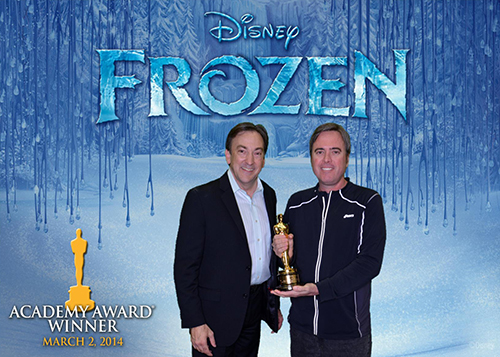
Producer Peter Del Vecho and my cousin, Brian Rishel, at the Studio's award party.

So, yeah, I liked Frozen, but I probably would have liked it more if I had known what it was about it before I watched it. The articles I read before actually seeing the movie had given me some false expectations.

I first became aware of Frozen’s existence early last fall when I read a blurb from one of the animators. This animator was discussing the challenges of working on an animation that featured “two female protagonists.” Two female protagonists? What a promising description! Princess stories have long been criticized for not including enough other female characters for the princess to relate to. Two princesses would certainly help right that wrong. Plus, while growing up, I was always very close with my own sisters, so this was a kind of relationship that I wanted to to see explored.

Unfortunately, the blurb was misleading. Frozen is not a story with “two female protagonists.” It is very much the story of Anna and her quest to save her magical sister.

Here’s a mostly spoiler-free plot summary: Elsa and Anna are the daughters of the royal family. Elsa was born with magic powers that let her conjure ice and snow. As she grows, Elsa becomes afraid that her powers will hurt someone, especially her beloved sister, Anna. So Elsa withdraws from everyone, including Anna. Finally, when her powers become too much to conceal, Elsa exiles herself. So Anna sets out on a quest to find her sister, help her control her powers, and save the kingdom from eternal winter. Along the way, Anna finds friends to help her and, somehow, acquires two handsome suitors. So, yeah, while Elsa may be the one who puts the plot into motion and gets the best song, the story clearly follows Anna’s journey.

There’s nothing wrong with making Anna the main character. (In fact, I find it interesting that the girl without magic powers gets to be the leading lady.) But I wanted to see more of Anna and Elsa working together. That line “two female protagonists” had me holding out hope that they would team up and cooperate sometime before the big finish. While familial love and sisterhood is the heart of the story, we rarely get to see the two girls enjoying that relationship.

I sort of thought kids would get more out of Frozen if they could see more of Anna and Elsa enjoying each other’s company. When I was a kid, I loved animated Disney movies, but not all of them stayed with me. The princess stories were the most quickly forgotten because they were the least relatable. Relatable stories were the ones I wanted act out with my brother and two sisters after the movie was over. If you suspect that my brother was the one who put a stop to princess tales, you would be wrong. My sisters and I gave up on princesses before he ever had a chance to veto them. Why? Because a princess has too much power, and that makes the narrative impossible to share with other girls. The girls who didn’t get to be the princess felt stuck waiting their turn in the spotlight. Playing the princess was even worse because of the guilt that came with putting oneself so far above the other sisters. So my family gravitated towards the stories that were about teams instead.

As an adult, I could see that same scenario play out whenever my little, princess-crazed cousins would try to reenact their favorite princess tales.  As soon as the idea to play princess came up, it either turned into a battle over who gets to be Sleeping Beauty, or their was lot of awkward hemming and hawing as they tried to figure out how to tell a fairytale with multiple princesses.

I wanted little girls to see Anna and Elsa getting along so that they could incorporate the friendship into their own narratives, and, perhaps into their own lives.

But, just because Frozen didn’t meet this expectation doesn’t mean it failed. Instead of a story of cooperation, Frozen is a tale of understanding. Everyone who’s ever had a sibling knows how Anna feels when she’s waiting for Elsa to spend some time with her, as well as how Elsa feels when she can’t give Anna that time and can’t quite explain why. Frozen is not the story of how we feel when we’re together, it’s about how we feel when we’re apart and what we’ll do to be together again.
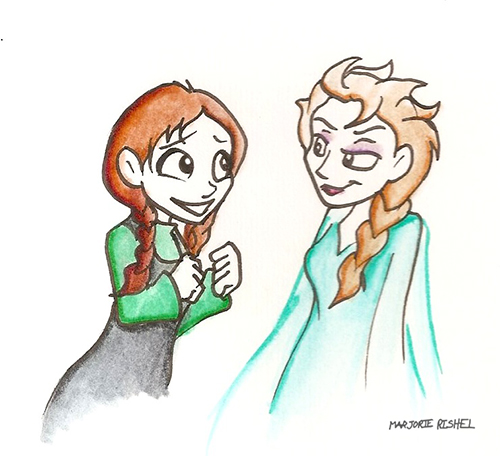


-Marjorie Rishel

Sunday, February 23, 2014

Chapter Six and Pre-Writing

You all know the old saying, "If you want to make God laugh, tell him your plans." I had a plan to post an eighteen-chapter graphic novel without missing updates to catch up on writing. See, I had written the entire script to Draconis Wicked two years before the first pages were ever drawn. I write Urban Underbrush one chapter at a time (with a few grand plans and threads secretly tying things together) but since Draconis Wicked is one story with a definite ending, it just made more sense to write the whole thing first and draw it second. This way, I could weave certain themes through the story, drop hints at what's ahead, and, of course, I'd never need to stop making new pages due to writer's block. 

As you may have noticed, I somehow managed to miss two updates in spite of all this prewriting. Shortly before I started drawing Chapter Five, I realized that I wanted to change the ending to Chapter Six. I won't give anything away, but the end of Chapter Six used a device that was interesting, but perfectly unremarkable in the Draconis world. I wanted to use this device in another story instead, where it would be a major turning point and an irreplaceable piece of the plot (more on that some other day). 

No big deal. I'd just swap the parts I wanted to save for later with similar devices and adjust the story that led up to it. Well, as soon as I took out the ending I realized that the rest of the chapter didn't work. I don't mean it didn't work without the original ending. I mean it never worked. But that big finish was distracting and interesting enough to keep me from noticing. Now that I was forced to revisit Chapter SIx without the same finale, I could see that the plot was hollow, the character personalities weren't quite right, and the whole thing seemed out of sync with the other chapters.

Members of the audience, you will never get to read Chapter Six in its original form. Never. Don't go getting curious. Reading it will only make you sad.

Rewriting Chapter Six proved difficult. I wasn't free to write whatever I felt like. Chapter Six had to accomplish certain goals, the most important one being that the end for the new Chapter Six still had to match up with the beginning of the old Chapter Seven. I found myself mentally pulling Chapter Six apart into it's basic components. I put the parts I liked in one pile and threw the rest away. It took a few passes to put the pieces back together into a unified story. Gradually, I recognized exactly which moments were holding me back and which themes I should have been exploring all along.

Now that I've finished the new script for Chapter Six, I feel like it was well worth the time and even the delays. The new Chapter Six isn't just "better than the old one," "good for a repair job," or "successfully patched all the holes." It's actually a good story. And if I've done my job, not only will you enjoy it, you won't even know that it wasn't a part of the original script.

Except I just told you.


Forget all that you read.

Marj

Sunday, February 2, 2014

Draconis Wicked - Chapter Five Retrospective

Today brought a close to Draconis Wicked Chapter Five: The Journal of Dr. Yapix.

SPOILER ALERT: Obviously, This blog will contain many references to Chapter Five and the previous chapters. If you don't want them to be spoiled, I suggest you read the comics first, then come back to the blog.

Chapter Five is one of my favorite chapters. In many ways, it sets the tone for the rest of the story. Chapter Five also gives us the last big piece of establishing information: the final destination of Draconis's journey.

If you're not sure what that means, then we should review everything that's happened so far:

Chapter One: Malcorona sends Draconis to investigate a lost treasure. Draconis learns about the Aurora Crystal and the magic barrier. He decides take the crystal for himself.

Chapter Two: Draconis goes to Phoenix Village, looking for someone he can trick into crossing the barrier for him.

Chapter Three: Draconis, Flight, and Snakey learn that no one can carry the Aurora Crystal across the barrier without absorbing its magic. They also learn about the secret passage to the treasury. Draconis decides to go out into the world and look for the passage entrance.

Chapter Four: Draconis and his crew have no idea where the entrance may be, but Chisel Town seems like a good place to start looking. They cross the Forest of Mists to get there.

Chapter Five: The mines of Chisel Town are a dead end. Instead the team finds Doctor Yapix, who figures out that the passage entrance is on the top of Mount Kyros.

As you can see, all of these early chapters are not exactly about Draconis going on his quest. They are about Draconis figuring out how to start his quest. It's sort of similar to Legend of Zelda games like A Link to the Past and Ocarina of Time. In these games, Link starts his adventure with a small quest (collecting spirit stones). When the small quest is complete (when Link gets the Master Sword), Link's real quest (the longer, tougher quest) is revealed to him. Draconis has finished his smaller quest and is now at the start of his real quest. Everything from now on will be about Draconis and his team finding a way to the top of Mount Kyros.

"Wait, how can the chapters ahead be the biggest part of the story? Can't Draconis just turn around and just walk up that Mountain?" Well, obviously, things are going to complicate this trip and Draconis won't be able to take the straightest path (even if he would like to.) If you need an estimate of how much longer this will take, I'd say the story is about 25% complete.

"Hey, you spent the first fourth of the story just getting to the starting point?" Well, I'm not in a hurry to finish Draconis Wicked. After all, it's a series of episodes, not a movie that needs to be told in two hours or less. But I also don't want this tale to linger on until everyone's bored with it. When I outlined the plot, I felt really comfortable with the length of each section and the length of the story as a whole. Spending this much time getting started won't seem strange by th time the stroy is through.

Besides, I may have dragged out some of the early chapters because they were my only chance to take advantage of different roles and character dynamics. Since a big part of the story is about building a team, it was important to enjoy each character combo while I had it. I can't go back to a point when it's just Draconis by himself, or just Draconis and Flight, so I had limited opportunities to play with those situations. I wanted to make sure I used these moments to their fullest before moving on to the next point.

"So, what's next?" One part of the story ends while another one begins. Some of the next chapters may feel a little different now that we have a larger team and a clearer goal. But much the mood will stay the same - Draconis still has the same attitude and the same relationship with his other party members. Speaking of which, Draconis has a real solid team now, but it's not quite complete yet. There are still plenty of reasons to keep reading. I hope you'll stick with us into the new frontier.

-Marj

Wednesday, January 22, 2014

Ninja Turtles and the Art of Villainy

It's been almost a month since actor James Avery passed away. I've been meaning to write something about his work in cartoons here, but it's taken me some time to sum it up properly.

When I was a kid, James Avery played The Shredder in the 1987 version of Teenage Mutant Ninja Turtles. When I was a teenager, James Avery played Uncle Phil on The Fresh Prince of Bel-Air. When I was an adult, James Avery was used as a piece of trivia (people my age were rather fond of asking "Did you know that The Shredder and Uncle Phil were the same guy?!")

Avery's depiction of The Shredder made a big impact on me. The character taught me a lot about how to write for villains.

Ever notice how when you're a kid, you can't always recognize the quality of children's entertainment? Sometimes, you watch a childhood movie in your adulthood and you find yourself thinking, "I never realized how good these jokes were," or "I never noticed how complex this theme music was." But every once in a while, you noticed exactly how good kid stuff was while you were still a kid. When I was a child, I recognized that James Avery's Shredder was the perfect Saturday morning cartoon villain.

What made 1987 Shredder the perfect (cartoony) villain? He had achieved the almost impossible feat of being equal parts frightening and funny. When he was angry, he was genuinely scary. When he was on the losing end of a joke, he was truly funny. True, Shredder would probably be scarier if he were never funny, or funnier if he were never scary. But he wasn't going for extremes. He was going for balance.

Balance between fear and humor is difficult. Think of any cartoon villain you know and you can probably classify them as either funny or scary. Very few of them will fit in both boxes. (Honorable mention for Batman's Joker - especially the Mark Hamill version - for being funny until it was scary. Not exactly the same as striking a balance, but worth a shout-out.)

Of course, crafting the perfect cartoon villain takes more than a good actor. There were two other parts to The Shredder's success:

First is the tone of the story. How you set up your world and its rules are going to influence the characters. Obviously, the main antagonist usually has to match the story's tone. Funny stories need comic-relief villains to keep them light. Serious stories need darker villains to keep the tension high. The 1987 version of Teenage Mutant Ninja Turtles had committed to stories that were equal parts action and comedy.

***I'm going to go on a tangent here, but I'll let you know when it's over. Some of you younger readers may not be as familiar with the 1987 TMNT cartoons. If you've grown up with the 2003 4Kids version or the 2012 Nickelodeon version, the campy cartoons from my childhood probably look like a mockery of the more comic book-faithful versions that you know and love. If this sounds like you,  then let me explain something about 1987. Back then, most cartoons were only run on network television. There was no internet or video-on-demand, direct-to-video was too expensive, and not everyone had cable. And the networks were only interested in "safe" ideas - ideas for stories that were likely to catch on with the biggest possible audience. Wacky sci-fi fantasy action stories like Teenage Mutant Ninja Turtles were not considered safe. But when it comes to drawing a large audience, humor is a powerful tool. As long as your jokes aren't divisive (ie, offensive, obscure, gross, etc.) a comedy will usually grab the biggest number of followers. Turning up the funny on the Ninja Turtles didn't automatically make it into a safe idea, but it made it safe enough for networks to give it a chance. The later versions of Ninja Turtles may never have been picked up at all if it weren't for all the fame and good will that the first series garnered. Okay, tangent over, now back to The Shredder.***

The second element to creating a balanced villain was the writing - specifically the "writer's bible." Ninja Turtles writers understood their characters. They made it clear that The Shredder was clever, tough, well-trained in the art of fighting, and willing to break any code of ethics to get what he wanted. These were the qualities that could evoke fear and suspense. The Shredder also had qualities that made him funny. His desire for power and control was childish in it's selfishness and he was prone to temper tantrums. On the other hand, he was also the only villain smart and wary enough to deliver dry, sarcastic one-liners about annoying heroes or henchmen. Basically, the writers came up with both funny and scary qualities for their character, made sure these qualities didn't contradict each other, then used them consistently in their storytelling.

Of course, all of this ground work would have gone to waste without an actor who throughly understood who the character was and knew what the writers were trying to accomplish with him. Mr. Avery's acting brought a very challenging character to life in the best possible way.

And so I salute the memory of James Avery. Your contributions to villainy were downright heroic.

-Marj

Sunday, January 5, 2014

New Year's Do-Over

Here we are, at the start of a magical new year, full of hope, promise and disease (I'll explain that last part in a moment.)

I've been unusually interested in making New Year's resolutions this time. Heaven knows that I have some bad habits that can be turned good and some good habits that can be turned better. Plus, lately I've been stumbling into all kinds of great articles on how to get your resolutions to stick. Most of the advice I've read has boiled down to two main ideas:

1.) Be open about your resolutions. Public resolutions are more likely to succeed than secret ones because your friends and well-wishers can support you and help keep temptation out of your way. (These articles didn't mention the shame of failing in front of all these people you just talked yourself up to, but I'm sure that's a factor.)

2.) Set goals you can measure. For example, a resolution to eat a better diet is kind of vague, but a resolution to serve kale twice a week and skip at least one dessert has measurable results, and a better chance of success.

Since I've just advocated going public with your resolutions, I'll confess that mine is to keep better track of my time. I suspect I'm wasting too much of it in my current routine. So, I've talked about this resolution to me friends, family and anyone else who'll listen. I've drawn up charts and calendars to track my hours and progress in my various jobs and chores. I've sworn off some time-wasting activities and even devised some plans to put a cap on web surfing.

And when January 1, 2014 came around and I was finally ready to spring my plans into action…I got sick. Twice.

Around 10:00am, on New Year's Day, I realized that I was coming down with a bad cold/cough. On January 2, I woke up with flu-like symptoms.These two illnesses had teamed up to keep me in a sick bed for the next three days. I have been unable to do much of anything besides sleep and waste time while my carefully made charts have slid further into the red.

But I am not about to quit and throw away a perfectly good resolution just because of a rough start. (Most of my best projects have had rough starts.) I can solve this problem simply by bending time a little bit. In other words, I am declaring a New Year's Do Over. 

A New Year's Do Over? How does it work? 

On January 10, everyone who chooses to participate has the option of restarting their resolutions, treating January 10 as if it were January 1 (resolution-wise - I don't have time to clean up another party). Why the tenth? Because it's a friendly, round number and I want to give people a chance to spread the word about the do-over. Besides, while traditional start of resolutions on January 1 New Year's is a bit like hitting a wall, the January 10 do-over gives you a few days to ramp up at you own pace, like that stretch of road they give you to merge onto the highway before you have to keep up with traffic.

I've been told that there is a great deal of illness going around, what with everyone being so social during the holidays, so if any of you other poor, afflicted sick people also need another shot at New Year's, here's your chance. If you've already broken your resolutions for any other reason, you too can start fresh on the tenth. Kept your resolution, but wish you'd written it differently? Consider it your ten-day test drive, then start your revised resolutions on January 10.

Yes, New Year's Do-Over Day: the first* of many holidays I will spontaneously invent as the need arises. Tell your friends!

-Marj


*Not actually the first.

Thursday, December 12, 2013

Urban Underbrush Chapter Twelve Retrospective

Well, dear readers, we've just wrapped up Urban Underbrush Chapter Twelve: House Inspection. Some of you may be curious about the changes to the comic world, and I'd like to tell you a little more about them.

If you haven't read Chapter Twelve yet, this is going to get pretty spoiler-heavy, so I suggest you go to the beginning and do the reading first. 

If you have finished the chapter, or don't care about spoilers, then let's get to it.

The most recent plot line has brought about the following changes:

1.) Dynamite and Detonator are temporarily done working for the rabbit family business.
2.) Dynamite and Detonator are now working for the landlord.
3.) Dynamite and Detonator will focus on building fireworks and novelties instead of knocking down buildings.

These are small but important modifications to the Urban Underbrush rules. 

I actually started writing the "House Inspection" story almost a year ago. Originally, it was going to be a silly, light-hearted escapade to follow the rather emotional Christmas Story. The original script involved Vincent tragically giving up his night off to assist with the inspection. Blair puts a hole in the floor by playing with Dynamite and Detonator's equipment, then runs off leaving Vincent to deal with the problem. Maxwell would cover the hole with a carpet scrap. Then Blair was supposed to fall through the afore mentioned hole right after the landlord went home ("Hey, how did you guys fix the hole so quickly - WhoOOAA!"). 

Then everything would return to normal.

It was a pretty good story. So, why did I change it?

Once I started to break this storyline down into comic strips, I found that none of the individual strips were interesting or funny. Whenever I have trouble turning a joke into a strip, I usually discover that the joke wasn't very funny to start with. But this was the first time that none of the strips seemed to work, no matter how I changed, tweaked, or rewrote them. If I can't get a single joke to work, there's probably something wrong with the joke. But if I can't get any jokes to work…is there something wrong with the comic?

In all honesty, this wasn't the first time Urban Underbrush had felt a little rickety to me. It was as if I was building on a cracked foundation and my once-steady walls were starting to shift and bend. If I ignored this problem and kept building, it was only going to get worse. I needed to stop and study the premise (the foundation) of Urban Underbrush. But I couldn't examine my work objectively while still writing new episodes. I needed to take a hiatus, hence the break over the spring and summer. During this time, I had two goals: 1.) Think about the kind of comic I want to write. 2.) Figure out what parts of the current comic are getting in the way of goal #1.

So, what kind of comic did I want to write…
I always wanted Urban Underbrush to focus on a large cast of both human and animal characters, with Dynamite and Detonator either driving each plot or acting as a catalyst to other people's problems. On examination, I realized that the jackrabbit family business was getting in the way of this. You may be thinking, "But, the rabbit family business was such a cool idea, how could it get in the way?" For one thing, it made the story kind of lop-sided. The rabbit family business was a huge plot point. Someone could easily write a whole series on just that one aspect. But it wouldn't be the story I wanted to write. Instead, the rabbit business was a competing "main idea" that was syphoning attention away from the Grass Roots House and splitting my story into pieces. 

So that's why the March Hare Demolition Company has stopped operating. I didn't want to disband it permanently - I just wanted to downplay its role enough to keep all my story elements in balance.

Making Dynamite and Detonator work for Claude the landlord seemed like another good idea. The other problem with rabbit business was that only Dynamite and Detonator got to interact with it. In many ways, this cut them off from the rest of the cast. It made my characters feel like boring realistic neighbors with their own separate lives instead of hilarious sitcom neighbors, always caught up in each other's business. Having Dynamite and Detonator work from the house seemed like the obvious solution to that problem.


The last big thing that bothered me about past Urban Underbrush was that there were never enough explosions. I think you can figure out why. Dynamite and Detonator knock down buildings. I can't have them smashing a different part of the crowded city in every episode, especially when they themselves live and a cherished historic building. In order to make the explosions occur more often, I just had to introduce smaller, less destructive explosions. Now that Dynamite and Detonator are building "safe" fireworks, an explosion can comically result in smoke and annoyance, instead of the loss of property, limbs, lives and such. Rest assured, there will still be large explosions when needed.

So, there's you breakdown of what's changed and the reasons why. I think the comic world will be better for them. Stick around. The best is yet to come.

-Marj

www.lepusstudios.com

Sunday, December 1, 2013

Comic Creators for Freedom 2013

December is upon us and the holiday season is beginning. This is the time of year where many of us are at our most charitable. If any of you are considering making donations to any worthy causes, I'd like to bring this one to your attention. Comic Creators for Freedom is holding another drive to help victims of modern day slavery.

From December 2 to December 14, Comic Creators for Freedom will be accepting donations for Love 146, a treatment facility for victims of slavery, kidnapping, and exploitation.

In return for a donation of any amount, you will receive an impressive gift. 167 different webcartoonists have each contributed a different character drawing, and all of these drawings have been combined into a desktop wallpaper. This high-res image is not available anywhere else. The only way to get one is to be contributor.

This year, the webcomic wallpaper has an extra special theme: awkward school photos! Yes, you can see 167 of your favorite characters as they would have looked in elementary school or high school. (I've seen the preview image - you can tell who went to school in the 80's and 90's.)

For my contribution, I drew Urban Underbrush's Leslie McGrath as an eleven-year-old grade schooler. As a reward for reading this far, I'm going to post a clip from my contribution:


If you want to see the whole thing, you have to go make a donation. Here's that link again: Comic Creators for Freedom

Again, I am honored to be able to take part in this. My deepest thanks to anyone who donates, or even passes the word along.


-Marj

www.lepusstudios.com